
Chuni Park
-
 Contemplation on the Road, 2024
 -
A Birch Forest, 2023
-
A Self-Portrait Overlooking the Sea, 2023
-
Autumn Leaves Trip, 2023
-
Forest of Healing #1, 2023
-
Forest of Healing #2, 2023
-
Healing Forest, 2023
-
Hydrangeas in the Moonlight, 2023
-
In the Forest #1, 2023
-
In the Forest #2, 2023
-
Scenery of Memory - Spring, 2023
-
Summer Vacation, 2023
-
Travel on Red Ground #1, 2023
-
The Memories of Autumn, 2022
-
A Rapturous Memory, 2021
-
A Landscape of Memories - Uluru #1, 2020
-
A Landscape of Memories - Uluru #2, 2020
-
Memories of Spring, 2020
-
Travel on Red Ground #2, 2020
-
Travel on Red Ground #3, 2020
-
View From the Sky #1, 2020
-
View From the Sky #2, 2020
-
View From the Sky #3, 2020
-
View From the Sky #4, 2020
-
View From the Sky #5, 2020
-
The Scenery of Memory - Ulsan Rock, 2018
-
Jeju Island's Forest Sea, 2017


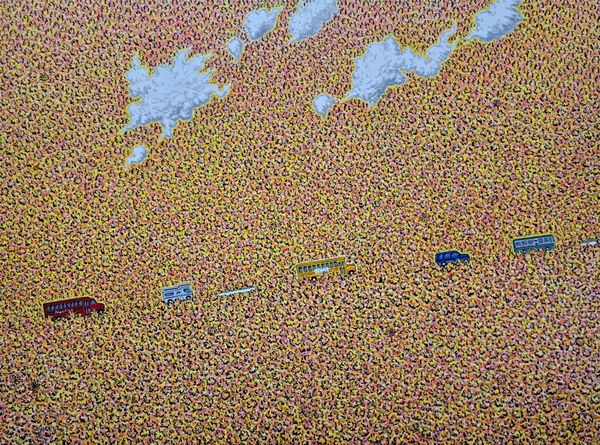


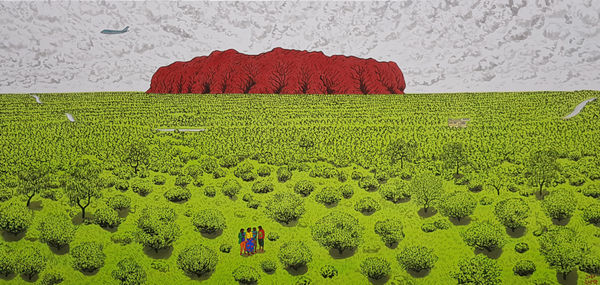


Chuni Park's paintings begin with restrained fields of black and white, onto which he layers vivid acrylic colors—a red bus, a yellow bench, a solitary figure. These artificial objects appear as traces of human presence within otherwise pure landscapes, creating tension between the natural and the constructed.
His work draws from Buddhist concepts of impermanence and the philosophical tradition examining how awareness of mortality shapes our experience of being alive. The large-scale canvases invite sustained looking; details that initially seem simple reveal themselves as deliberate compressions of space and time.
Park's practice reflects a meditation on existence that unfolds visually rather than verbally.

Born in a rural farming village in Korea's Chung-chong province, Chuni Park discovered his artistic calling through soul-searching bicycle journeys and early experiments selling paintings in Seoul. This awakening led him to enroll at Hong-ik University at a later age, where his unconventional start fueled 28 years of dedicated artistic practice.
Focusing on "traditional painting"—then considered antiquated—Park envisioned its vital importance in an era of globalization. Through intensive studies of Eastern philosophy, he merges tradition with modernity, combining traditional themes rooted in local culture while breaking free from conventional Korean painting's rigid structures.
Park's practice extends beyond the studio through regular nature treks, where he sketches in situ to develop his signature pil-beop (brush technique). His "blurry landscape" series powerfully captures everyday domestic life within natural settings. Working with hanji (Korean paper) and muck (Korean soot-based ink), he also creates ephemeral chalk drawings on blackboards that he erases upon completion, embracing the Eastern philosophy of non-possession.
In innovative installations, Park hangs paintings like meat in a butcher shop, creating navigable mazes that viewers experience through their entire bodies. He has expanded his materials to include rubber, instant noodles, plastic bags, and blue duct tape, revealing landscapes through his distinctive perspective.
Through consistent experimentation without commercial compromise, Park has created his own genre within traditional Korean painting, offering international audiences a fresh perspective that honors heritage while pushing contemporary boundaries.